Readings Bio Archives Charts Tools Home Links


Gemini: Sign, Constellation and Myth


Gemini finds its place in the Air triplicity, as the mutable (or common) expression of that element. The Air triplicity is concerned with mental activities. Gemini is the third sign of the zodiac whose elemental nature is hot and moist, masculine, human and barren. 

Those with strong Gemini signatures in their charts are animated, often using their hands as well as their speech when they communicate. The sign is mentally active and often restless. It signifies all forms of written and verbal communication, particularly journalism and any occupation interested in commenting on social affairs. Gemini's opposite sign is Sagittarius, the mutable Fire sign. 

Gemini is ruled by Mercury S, the most mutable of all planetary energies. If we consider the seven Classical planets, we find the two luminaries, the Sun and Moon, embodying the primary male and female qualities. Mercury is neither male nor female, diurnal nor nocturnal and in fact embodies the neutral or hermaphroditic qualities necessary to serve as messenger of both the yin and yang qualities of the Self. 

Like the element mercury, Gemini likes to run over the surface of things, without penetrating the surface. This manifests as the joy of intellectual play, but can also bring shallowness and the 'social butterfly' effect. Gemini is a dual sign and needs focus in order to resolve the conflicting natures or their being as illustrated in the myth of Castor and Pollux. The key word for Gemini is Self Knowledge. When the native has advanced to a more conscious level and achieved this knowledge, they are very capable of achieving the magical attributes of Hermes.. 


The Constellation Gemini 

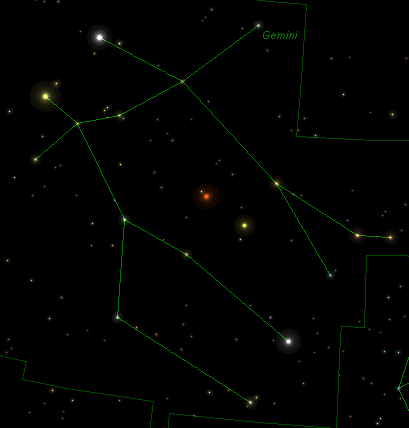
Below: The constellation of Gemini as seen in the Northern Hemisphere, 29 may 2004. Castor (white) and Pollux (yellow) are the bright stars at the top of the constellation. Note Mars (red) and Saturn (yellow) are both in sidereal Gemini. Star map calculated using Cartes du Ciel astronomical software.


The following retelling of the Castor and Pollux myth is from Bulfinch's Mythology

Castor and Polydeuces (Pollux) were the offspring of Leda and the Swan (see below) under which disguise Zeus had concealed himself. Leda gave birth to an egg from which sprang the twins. Helen, so famous afterwards as the cause of the Trojan War, was their sister.

When Theseus and his friend Pirithous had carried off Helen from Sparta, the youthful heroes Castor and Polydeuces, with their followers, hastened to her rescue. Theseus was absent from Attica and the brothers were successful in recovering their sister.

Castor was famous for taming and managing horses, and Polydeuces for skill in boxing. They were united by the warmest affection and inseparable in all their enterprises. They accompanied the Argonautic expedition. During the voyage a storm arose, and Orpheus prayed to the gods, and played on his harp, whereupon the storm ceased and stars appeared in the heads of the brothers. From this incident, Castor and Polydeuces came afterwards to be considered the patron deities of seamen and voyagers, and the lambent flames, which in certain states of atmosphere play round the sails and masts of vessels, were called by their names.

After the Argonautic expedition, we find Castor and Polydeuces engaged in a war with Idas and Lynceus. Castor was slain, and Polydeuces, inconsolable for the loss of his brother, besought Zeus to be permitted to give his own life as a ransom for him. Zeus so far consented as to allow the two brothers to enjoy the boon of life alternately, passing one day under the earth and the next in the heavenly abodes. According to another form of the story, Zeus rewarded the brothers by placing them among the stars as Gemini the Twins. They received divine honours under the name of Dioscuri."

Addenda:

Leda

Leda was approached by the god Zeus , disguised as a swan. Zeus made love to her in this form.The memorable union between Leda and the Swan (actually Zeus) has long been portrayed by painters and poets. In addition to influencing artists, however, this coupling also influenced mythology. There another twist - the legend is that Helen was born from an egg because her father Zeus appeared as a swan when he impregnated Leda. Some versions of the tale claim that it was the goddess Nemesis who laid the egg from which Helen hatched. Additionally, some ancient sources state that Polydeuces was also the son of Zeus, while his twin brother Castor was the child of Tyndareus.


x

Correggio: Leda and the Swan

Article and page design, copyright. P. James Clark 2004

HOME