|
EDMOND HALLEY'S FAMOUS ADMONITION of 1716
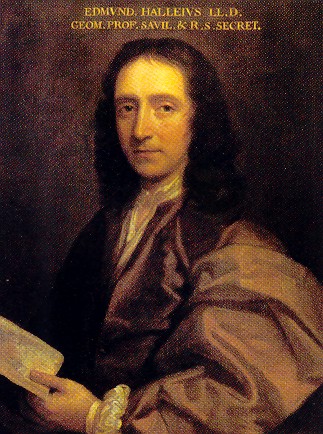
PHILOSOPHICAL TRANSACTIONS VOL. XXIX (1716) A new Method of determining the Parallax of the Sun, or his Distance from the Earth; by Dr. Halley, Sec. R. S. N0 348, p.454. Translated from the Latin. I have added the portrait of Edmund Halley and corrected what were obvious typos, such as 'Coper-nicus' and 'in- struments. ' In all other respects, the text remains unedited [PJC]. _________________________________________________________________________________________
It is well known that this distance of the sun from the earth, is supposed different by different astronomers. Ptolemy and his followers, as also Copernicus and Tycho Brahe, have computed it at 1200 semi-diameters of the earth, and Kepler at almost 3500; Riccioli doubles this last distance, and Hevelius makes it only half as much. But at length it was found, on observing by the telescope, Venus and Mercury on the sun's disk, divested of their borrowed light, that the apparent diameters of the planets were much less than hitherto they had been supposed to be; and in particular, that Venus's semi-diameter, seen from the sun, only subtends the fourth part of a minute, or 15 seconds; and that Mercury's semi-diameter, at his mean distance from the sun, is seen under an angle of 10 seconds only, and Saturn's semi-diameter under the same angle; and that the semi-diameter of Jupiter, the largest of all the planets, subtends no more than the third part of a minute at the sun. Whence, by analogy, some modern astronomers conclude that the earth's semi-diameter, seen from the sun, subtends a mean angle, between the greater of Jupiter and the less of Saturn and Mercury, and equal to that of Venus, viz. one of 15 seconds; and consequently, that the distance of the sun from the earth is almost 14,000 semi-diameters of the latter. Another consideration has made these authors enlarge this distance a little more: for since the moon's diameter is rather more than a quarter of the earth's diameter, if the sun's parallax be supposed 15 seconds, the body of the moon would be larger than that of Mercury, viz. a secondary planet larger than a primary one, which seems repugnant to the regular proportion and symmetry of the mundane system. On the contrary, it seems hardly consistent with the same proportion, that Venus, an inferior planet, and without any satellite, should be larger than our earth, a superior planet, and accompanied with so remarkable a satellite. Therefore, at a mean, supposing the earth's semi-diameter, seen from the sun, or which is the same thing, the sun's horizontal parallax, to be 12 seconds and a half, the moon will be less than Mercury, and the earth larger than Venus, and the sun's distance from the earth come out nearly 16500 semi-diameters of the earth. I shall admit of this distance at present, till its precise quantity be made to appear more certain by the trial I propose; not regarding the authority of such as set the sun at an immensely greater distance, relying on the observations of a vibrating pendulum, which do not seem accurate enough to deter-mine such minute angles; at least, such as use this method will find the parallax sometimes none at all, and sometimes even negative; that is, the distance will become either infinite, or more than infinite, which is absurd. And it is scarcely possible for any one certainly to determine, by means of in-instruments, however nice, single seconds, or even 10 seconds; and therefore, it is not at all surprising, that the exceeding minuteness of such angles has hitherto baffled the many and ingenious attempts of artists. While I was making my observations in the island of St. Helena, about 40 years since, on the stars round the south pole, I happened to observe, with the utmost care, Mercury passing over the sun's disk: and contrary to expectation, I very accurately obtained, with a good 24-foot telescope, the very moment in which Mercury, entering the sun's limb, seemed to touch it internally, as also that of his going off; forming an angle of internal contact. Hence I discovered the precise quantity of time the whole body of Mercury had then appeared within the sun's disk, and that without an error of one single second of time; for, the thread of solar light, intercepted between the obscure limb of the planet, and the bright limb of the sun, though exceedingly slender, affected my sight, and in the twinkling of an eye, both the indenture made on the sun's limb by Mercury entering into it, vanished, and that made by his going off, appeared. On observing this I immediately concluded, that the sun's parallax might be duly determined by such observations, if Mercury, being nearer the earth, had a greater parallax, when seen from the sun; for, this difference of parallaxes is so very inconsiderable, as to be always less than the sun's parallax, which is sought; consequently, though Mercury is to be frequently seen within the sun's disk; he will scarcely be fit for the present purpose. There remains therefore Venus's transit over the sun's disk, whose parallax, being almost 4 times greater than that of the sun, will cause very sensible differences between the times in which Venus shall seem to pass over the sun's disk in different parts of our earth. From these differences, duly observed, the sun's parallax may be determined, even to a small part of a second of time; and that without any other instruments than telescopes and good common clocks, and without any other qualifications in the observer than fidelity and diligence, with a little skill in astronomy. For we need not be scrupulous in finding the latitude of the place, or in accurately determining the hours with respect to the meridian; it is sufficient, if the times be reckoned by clocks, truly corrected according to the revolutions of the heavens, from the total ingress of Venus on the sun's disk, to the beginning of her egress from it, when her opaque globe begins to touch the bright limb of the sun; which times, as I found by experience, may be observed even to a single second of time. But
by the limited laws of motion, Venus is very rarely seen within the
sun's disk; and for a series of 120 years, and upwards, is not to be
seen there once; viz. from 1639, when Mr. Horrox was favoured with
this agreeable sight, and he the first and only one since the
creation of the world, down to 1761; at which time, according to the
theories hitherto observed in the heavens, Venus will pass over the
sun on May 26 in the morning; so that (vide Phil. Trans. N0 193) at
London, nearly at 6 o'clock in the morning, she is to be in the
middle of the sun's disk, and but 4 minutes more southerly than his
centre. The duration of this transit will be almost 8 hours; viz.
from 2 till near Supposing the sun's parallax, as was said, to be 12 seconds and a half, Venus's parallax will be 43 seconds; and subtracting the sun's parallax, there will remain half a minute at least for the horizontal parallax of Venus from the sun, and consequently, Venus's motion will be accelerated ¾ of a minute at least by that parallax, while she passes over the sun's disk, in such elevations of the pole as are near the Tropic; and still more so near the equator. For Venus will at that time accurately enough describe within the sun's disk 4 minutes an hour; and consequently, at least 11 minutes of time (by which the duration of this eclipse of Venus will be contracted by reason of the parallax) answer to ¾ of a minute. And by this contraction alone we might safely determine the parallax, provided the sun's diameter and Venus's latitude were very accurately given; which yet we cannot possibly bring to a calculation, in a matter of such great subtlety. We must therefore have another observation, if possible, in places where Venus possesses the middle of the sun at midnight, viz. under the opposite meridian, that is, 6h or 90° more westerly than London, and where Venus enters the sun's disk a little before his setting, and goes off a little after his rising; which will happen in the said meridian in about 56° of N. lat. that is, at Nelson's harbour in Hudson's Bay. For, in the neighbouring places Venus's parallax will protract the duration of the transit, and make it at least 6 minutes longer; because while the sun seems to tend under the pole from west to east, these places on the earth's surface will seem to be carried with a contrary motion towards the west, that is, with a motion conspiring with the proper motion of Venus; consequently Venus will seem to move slower within the sun's disk, and continue longer on it. If
therefore in both places this transit happen to be duly observed by
proper persons, it is evident that the Mora will be longer by 17
entire minutes in Nelson's harbour, than in the East-Indies; nor
does it matter much whether the observation be made at Fort St.
George, commonly called Maderas, or at Bencoolen on the western
coast of the island of Sumatra near the equator. But if the French
should incline to make the observation, By this means, the sun's parallax may be discovered, to within its five hundredth part, which will doubtless seem surprising to some: but yet, if an accurate observation be had in both the places above-mentioned, it has already been shown that the duration of these eclipses of Venus differ from each other by 17 entire minutes, on the supposition that the sun's parallax is 12½ seconds. And if this difference be found to be greater or less by observation, the sun's parallax will be greater or less nearly in the same ratio. And since 17 minutes of time answer to 12½ seconds of the sun's parallax; for each second of the parallax there will arise a difference of upwards of 80 seconds of time; therefore, if this difference be obtained true within 2 seconds of time, the quantity of the sun's parallax will be got to within the 40th part of one second; and consequently his distance will be determined to within its 500th part; at least if the parallax be not found less than what I have supposed it; for 40 x 12½ is 500. Here I have had no regard to the planet's latitude, both to avoid the trouble of a more intricate calculation, which would render the conclusion less evident, as also on account of the motion of the nodes of Venus not being hitherto discovered, and which can only be duly determined by such conjunctions of the planet with the sun as this. For it was only on the supposition, that the plane of Venus's orbit is immoveable in the sphere of the fixed stars, and that her nodes would continue in the same places as they were in 1639, that it was concluded, that Venus would pass 4 minutes below the sun's centre. But if in 1761 she should pass more southerly, it will be evident, that there is a regression of the nodes; and if more northerly, that there is a progression of them; and that at the rate of 5½ minutes in 100 Julian years, for each minute by which the path of Venus will at that time be more or less distant from the sun's centre than the said 4 minutes. But the difference between the durations of these eclipses will be somewhat less than 17 minutes, by reason of the southern latitude of Venus; but greater if, by the progression of the nodes, she shall pass over the sun to the north of his centre.
But
for the sake of such as are not thoroughly acquainted with the
doctrine of parallaxes, I shall further explain the matter both by a
figure and a somewhat more accurate calculation. Therefore,
supposing that at London, May 25, 17h55m, 1761, the sun be in 15°
37' of Gemini, and consequently that at his centre the ecliptic
tends towards the north in an angle of 6° 10'; and that the visible
path of Venus within the sun's disk at that time descends towards
the south, forming an angle with the ecliptic of 8° 28'; then the
path of Venus will tend a little towards the south in respect of the
equator, intersecting the parallels of declination in an angle of 2°
18'. Supposing likewise that Venus be
near the sun's centre at the said time, and distant from it towards
the south 4 minutes, describing, by a retrograde motion on the sun's
disk, 4 minutes an hour. The sun's semi-diameter will be nearly 15'
51", and that of Venus 37½". And supposing, for trial
sake, the difference of the horizontal parallaxes of Venus and the
sun to be 31", such as it is on the supposition of the sun's
parallax being 12½". Therefore let a small circle, as AEBD,
fig. 3, pl. 5, be described from the centre C, whose
semi-diameter let be 31", representing the earth's disk, and in
it drawing DabE and cde the ellipses of the parallels
of 22 and 56° N. lat. in the same manner as is now used by
astronomers for constructing solar eclipses: and let BCA be
the meridian in which the sun is, to which let be inclined the right
line FHG, representing the path of Venus, in an angle of 2°
18', whose distance from the centre C let be 240 such parts
as BC is 31; and from C let fall the right line CH
perpendicular upon FG. Then supposing the planet in H
at 17h55m, or 5h55m in the morning, let the right line FHG be
divided into the horary spaces III; IV, IV; V, V; VI, &c. equal
to CH, that is, 4 minutes. Let the right line KL be
also equal to the difference of the apparent semi-diameters of the
sun and Venus, or 15' 13½". Then the circle, described with
the radius KL, and from any point within the small circle,
representing the earth's disk as a centre, will meet the right line FG
in the point denoting what o'clock it is at London, when Venus shall
touch the sun's limb in an angle of internal contact, in that place
of the earth's superficies that lies under the assumed point on the
disk. And if a circle, described from the centre C and with
the radius KL, meet FG in the points F and G,
the right lines FH, HG will be = 14' 41", which
Venus will appear to pass over in 3h40m. Therefore F will
fall upon 2h5m at Now
in the meridian itself Venus will be near the sun's centre at the
eastern mouth of the But
adapting the calculation to Nelson's harbour, I find that Venus
shall pass over the sun's disk, when he is just about to set, and
emerge out of his disk immediately after his rising, that place in
the mean time being carried through the hemisphere opposite to the
sun from c to d, with a motion conspiring with that of
Venus. Therefore the mora of Venus within the sun's disk will become
longer by reason of the parallax, suppose by 4 minutes, so as
entirely to be 7h24m or 111° of the equator. And since the latitude
of the place is 56°, it will be as the square of the radius is to
the rectangle under the sines of 55½° and 34°, so is AB =
1' 2" to cd = 28" 33"'. And on duly making the
calculation, it will appear, that the circle, described from the
centre c, with the radius KL, will meet the right line
FH in O, at 2h12m45s; but described from the centre d,
it will meet HG in P, at 9h36m37s. Therefore the
duration of the mora at Nelson's harbour will be 7h23m52s, viz.
greater than at the mouth of the From the above hypothesis it follows, that at London Venus will rise when entered into the sun, and at 9h37m in the morning in her egress touch internally the sun's limb, and quite leave his disk not before 9h56m. It is evident from the same hypothesis, that Venus should touch with her centre the extreme northern limb of the sun on May 23, 11h, 1769, so that, by reason of the parallax, her whole body may be seen in the northern parts of Norway, within the sun's disk; while on the coast of Peru and Chili she will seem to ride on the disk of the setting sun with a small segment of her body; as in like manner in the Molucca islands, and the neighbouring parts, at sun-rising. But if the nodes of Venus be found to have a retrocession, as there is reason to suspect from some later observations, then her whole body being every where seen within the sun's disk, the greatest differences of these eclipses will afford a still more evident proof of the sun's parallax.* __________________________________________________________ * The transit of Venus in 1761 proved much less favourable to the proposed purpose than Dr. Halley expected. The motion of Venus's node not being well known, she passed much nearer the sun's centre than he supposed she would; which made the places he pointed out for observing the total duration not proper for the purpose; indeed the entrance of Venus on the sun could not be seen at Hudson's Bay. He made a mistake too in the calculation, in taking the sum instead of the difference, of the angle of the ecliptic with the parallel to the equator, and the angle of Venus's path. This translation of Halley's paper is taken from the Abridged Transactions of the Royal Society, Volume VI, pp.243-249, published in 1809. |